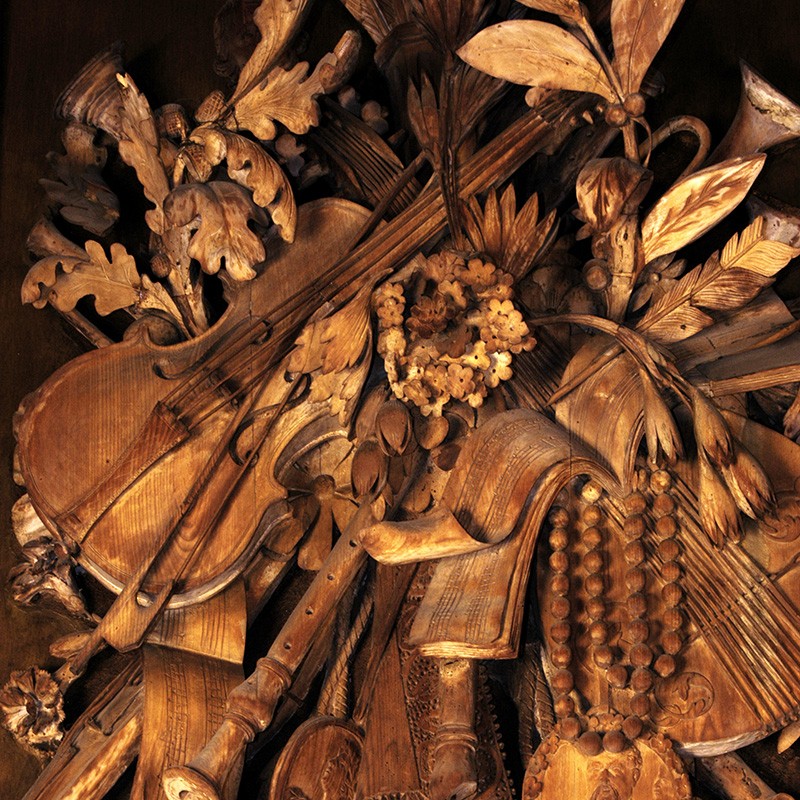
A late-seventeeth-century carving at Petworth House, UK.Credit: The National Trust Photolibrary/Alamy
The Age of Wood: Our Most Useful Material and the Construction of Civilization Roland Ennos Scribner (2020)
Wood runs like a vein throughout human history. It is integral to everything from early copper and iron smelting to wheels, windmills, Viking longships, Celtic barrels, Renaissance crumhorns and Stradivarius violins. It was even the subject of the first book published by a nascent Royal Society troubled by the rapacious demands of a seafaring empire (see G. Hemery Nature 507, 166–167; 2014).
All this and more is dovetailed in The Age of Wood, a lively history of biology, mechanics and culture that stretches back 60 million years, from the evolution of small, tree-dwelling, bush babies, with which humans share a common ancestor. It ends in our more sobering modern times, as megafires, propelled by climate change, incinerate millions of hectares in Australia and the United States, and thousands of square kilometres of Brazilian rainforest are razed to make way for mining and cattle ranching.
For much of human history, our impact on forests has been much more benign, argues biologist Roland Ennos. Even while using wood to make spears, tools, axe handles, huts and boats, our forebears found ways to protect the source of this most versatile material. Superior skills with wood had an outsize role in our evolution, from an ability to sharpen digging sticks with teeth or stones — a skill ascribed to semi-arboreal early hominins — to the control of fire, which enabled our ancestors to cook meat, allowing them to absorb more energy from it than from raw flesh, and so maintain a larger brain.
The forgotten age
A specialist in the mechanics of wood, Ennos has a fierce love for his topic. Archaeologists and anthropologists, he writes, tend to focus all their attention on stone, bronze and iron tools — to the extent that nineteenth-century Danish antiquarian Christian Thomsen classified the “ages of man”, according to these materials. The “Age of Wood” has been effaced, along with its fragile, rapidly decaying remnants.
The earliest evidence for woodworking comes from a 1.5-million-year-old Homo erectus site called Peninj in Tanzania. Here, researchers found residues of acacia wood clinging to stone hand axes. Most likely used to carve spears, these axes “may not seem much of an advance”, Ennos writes, but “it involved a step change in the human imagination”. Wood was handy for hunting: the earliest recorded wooden tool, the yew-hewn Clacton Spear, is 400,000 years old. Discovered near a UK coastal town, it might have been a weapon, a snow probe or a lance. Aboriginal Australians invented boomerangs at least 20,000 years ago, as evidenced by rock art.
It was during the Neolithic period, beginning about 12,000 years ago, that humans first made a major impact on the environment. As the climate warmed and forests advanced northwards, humans hafted small flint blades onto wooden handles to craft ‘tranchet’ axes to cut down trees, clearing land for agriculture and leading to the rise of a new material culture. They also began coppicing — cutting trees such as oak, ash, and chestnut down to ground level every two decades or so to stimulate rapid re-sprouting from dormant buds low in their trunks. In California, the Wintu and Cahuilla peoples developed “balanoculture”, caring for oak forests and living on foods made from acorn flour.
Production paradox
Paradoxically, as Ennos explains, the smelting of metals such as copper made people even more reliant on wood. A key element in these processes is burning charcoal, generated by heating wood to high temperatures. And metals such as copper and bronze make better axes for chopping down trees.
Having depleted their own forests, emerging empires looked elsewhere. Ennos describes the arms race that developed in the late seventeenth century between France and Britain. As the nations competed to build their navies, they needed trees tall enough to craft masts up to 36 metres long. For France, the wilds of the Pyrenees mountains yielded huge fir trees; in Britain, tree cover had been slashed to less than 10%. The country turned to its American colonies, “where the old-growth forests of New England contained huge, straight-trunked white pine trees in seemingly limitless numbers”. Growing up to 70 metres tall, they became the British Navy’s “tree of choice”.
Before European colonists arrived, what is now the United States had about 400 million hectares of forests, covering half the total land area. Settlers cleared about 116 million hectares, roughly the size of Colombia. In Barbados — which was apparently named after the bearded fig tree (Ficus citrifolia), by Portuguese explorer Pedro a Campos — 95% of the original forest cover was cleared to make way for sugar cane. Cultivated and cut by enslaved African people, it was a source of monstrous wealth for British plantation owners.
It’s hard to maintain a sense of optimism in the face of continuing forest decimation, yet Ennos makes valiant efforts. He points to mass-tree-planting projects in Ethiopia (almost 354 million trees planted in one July day in 2019); and rewilding on the Knepp Estate in West Sussex, UK. Allowing vast areas of abandoned farmland and grassland in Europe, New England and New Zealand to revert to forest, he argues, could absorb billions of tonnes of heat-trapping carbon dioxide. It’s an appealing counterpoint to the sense of doom many feel in these apocalyptic times.
Reading about rewilding, I think back to a beloved picture that hung in my grandparents’ house: a reproduction of John Constable’s 1821 masterpiece, The Hay Wain. In the sleepy scene, black poplar trees tower over the waters of England’s River Stour in which the eponymous wain stands, spoke-deep. It was once common practice, I learn from Ennos, for farmers to leave their carts in shallow pools to keep the wooden wheels swollen and the joints taut. Sad to say, the poplars Constable conjured with splodgy strokes were cut down to make carts, house frames and farm equipment, as well as rifle butts for the First World War. One can’t help longing for the return of that lush, woody world.
"wood" - Google News
December 01, 2020 at 09:01PM
https://ift.tt/2KXmnY8
Wood — the vein that runs through human history - Nature.com
"wood" - Google News
https://ift.tt/3du6D7I